Pressure Washer Job Matcher
Ever watched a pro clean a driveway in half the time it takes you and wondered what’s under that hood? It’s not just muscle; it’s the right machine. Most homeowners grab a standard shop-brand unit from the hardware store, but professionals rely on specific types of pressure washers built for endurance, power, and precision. If you’re looking to upgrade your game or hire someone who actually knows their stuff, understanding the difference between residential and commercial gear is key.
The short answer? Pros don’t use one single type. They match the tool to the job. For heavy-duty concrete restoration, they reach for a gas-powered triaxial pump unit. For delicate brickwork or vehicle detailing, they switch to a lower-PSI electric model or even a soft-washer system. The "professional" label isn't about having the loudest, strongest machine-it's about having the *right* machine for the surface you're treating.
The Core Difference: Residential vs. Commercial Specs
To understand what pros use, you first have to understand why your home unit falls short. A typical consumer pressure washer operates at around 1,500 to 2,000 PSI (Pounds per Square Inch) with a flow rate of 1.5 to 2.5 GPM (Gallons Per Minute). That’s fine for rinsing mud off a patio or cleaning a car. But when you’re tackling decades of oil stains on an asphalt road or removing graffiti from a brick wall, you need more grunt.
Professional-grade units typically start at 3,000 PSI and go up to 4,000+ PSI, with flow rates exceeding 3.5 GPM. This combination creates a higher energy density, meaning the water hits the surface with significantly more force. However, raw power isn't everything. The durability of the internal components matters just as much. A pro needs a machine that can run for 8-hour shifts without overheating or leaking.
| Feature | Residential Unit | Professional Unit |
|---|---|---|
| PSI Range | 1,500 - 2,500 PSI | 3,000 - 4,500+ PSI |
| GPM Flow Rate | 1.5 - 2.5 GPM | 3.0 - 4.5+ GPM |
| Pump Type | Single-axis or Triplex (plastic heads) | Triplex (steel/brass heads) or Axial |
| Power Source | Electric (mostly) | Gas/Petrol (primary), Electric (detailing) |
| Duty Cycle | Intermittent (15-30 mins) | Continuous (8+ hours) |
Gas-Powered Units: The Heavy Lifters
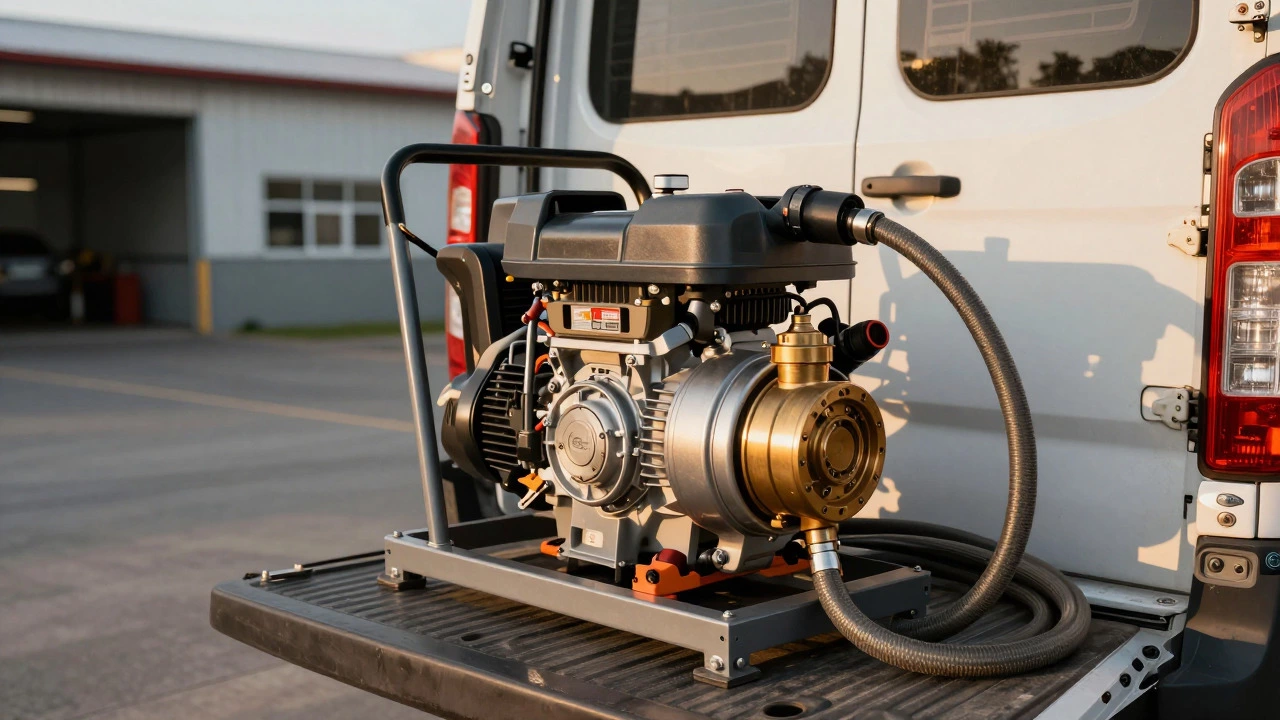
If you see a truck rolling up to a construction site or a large commercial property, it’s almost certainly carrying a gas-powered pressure washer. These are the workhorses of the industry. Brands like Kärcher is a German manufacturer known for industrial cleaning solutions, Karcher Professional, and Husqvarna is a Swedish company producing outdoor power equipment dominate this space. Why gas? Because electricity limits your range and power output. A gas engine provides consistent, high-volume output regardless of where you are, making it ideal for large driveways, warehouse floors, and exterior building facades.
These machines usually feature a triplex pump design. Unlike the simpler axial pumps found in cheap models, a triplex pump uses three pistons working in sequence to deliver a smoother, more consistent stream of water. This reduces vibration and extends the life of the hoses and nozzles. You’ll often see these units equipped with a hot-water capability. Hot water breaks down grease and grime far more effectively than cold water, which is crucial for kitchen exteriors, restaurant patios, and industrial machinery cleaning.
Electric Models: Precision and Detail Work
Not every job requires a roaring gasoline engine. For interior work, vehicle detailing, or cleaning delicate surfaces like painted wood or stucco, professionals often switch to high-end electric pressure washers. Companies like Nilfisk is a Danish manufacturer of professional cleaning equipment produce electric units that rival gas models in performance but offer quieter operation and zero emissions. This makes them perfect for office buildings, hospitals, and residential areas where noise complaints are a real concern.
Modern professional electric units aren’t the flimsy gadgets you buy for $200. They feature metal pumps, thermal overload protection, and variable pressure controls. This allows the operator to dial down the PSI instantly if they hit a fragile area. For example, when cleaning a historic brick wall, a pro might start at 2,000 PSI to remove loose dirt and then drop to 1,000 PSI to avoid eroding the mortar joints. This level of control is rare in budget consumer models.
The Role of Nozzles and Accessories
You can have the most powerful machine in the world, but if you use the wrong nozzle, you’ll either do no work or destroy the surface. Professionals carry a full set of interchangeable nozzles, each color-coded by spray pattern:
- White (40-degree): Wide fan, low pressure. Used for pre-rinsing and applying detergent.
- Green (25-degree): Medium fan, moderate pressure. Good for general cleaning of driveways and decks.
- Yellow (15-degree): Narrow fan, high pressure. Effective for tough stains on concrete.
- Red (0-degree): Pinpoint jet, maximum pressure. Reserved for cutting away paint or severe corrosion. Rarely used on finished surfaces due to etching risk.
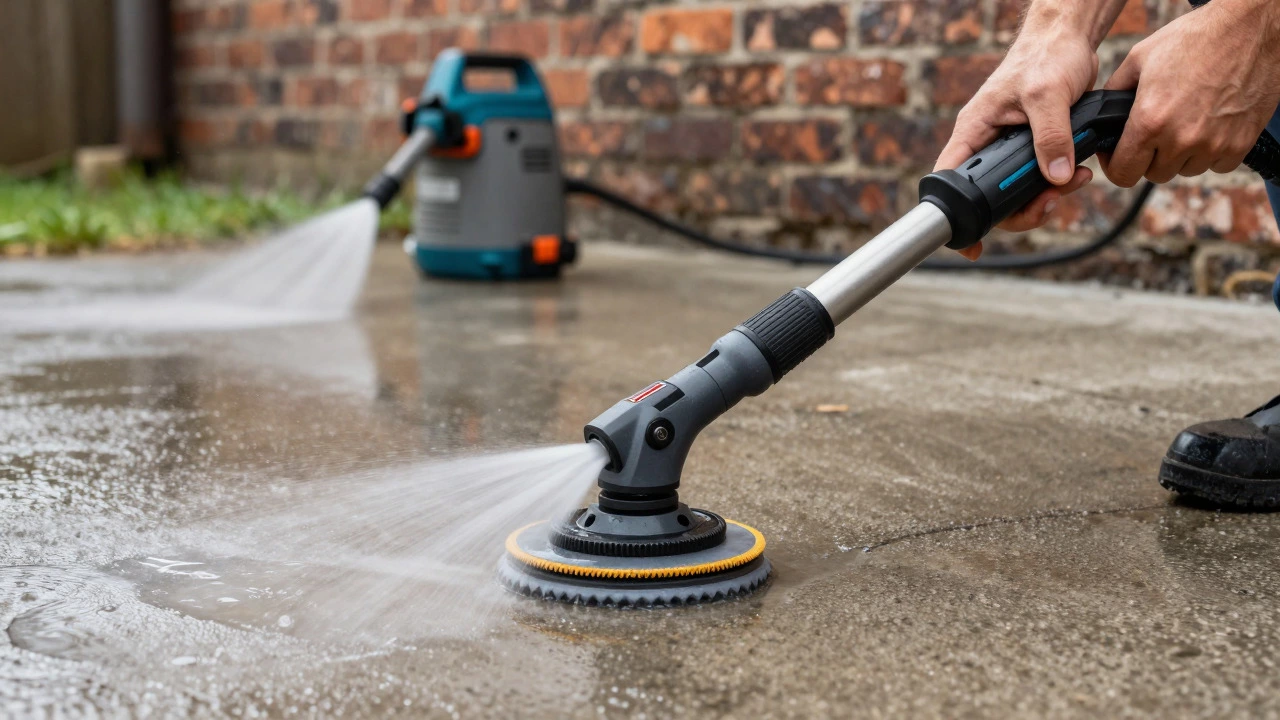
Beyond nozzles, pros rely heavily on surface cleaners. These are disc-shaped attachments that sit flat against the ground, spraying water in a circular pattern. They cover large areas faster than a wand and leave a uniform finish without the "tiger striping" effect common with handheld wands. For textured surfaces like pavers, a multi-surface nozzle might be used to blast into the gaps without displacing the stones.
Choosing the Right Tool for Your Job
So, how do you decide what to use? It comes down to the material you’re cleaning and the scale of the project.
- Concrete Driveways: Go with a gas-powered unit rated at 3,000+ PSI. Use a green or yellow nozzle. Add a surface cleaner for speed.
- Wood Decks: Use an electric unit or a gas unit with a white/green nozzle. Keep the distance at least 10 feet away to avoid splintering the wood. Never use the red nozzle here.
- Brick and Stucco: Caution is key. Start with a green nozzle at a distance. If using gas, ensure it has a pressure regulator to drop the output below 2,000 PSI if needed.
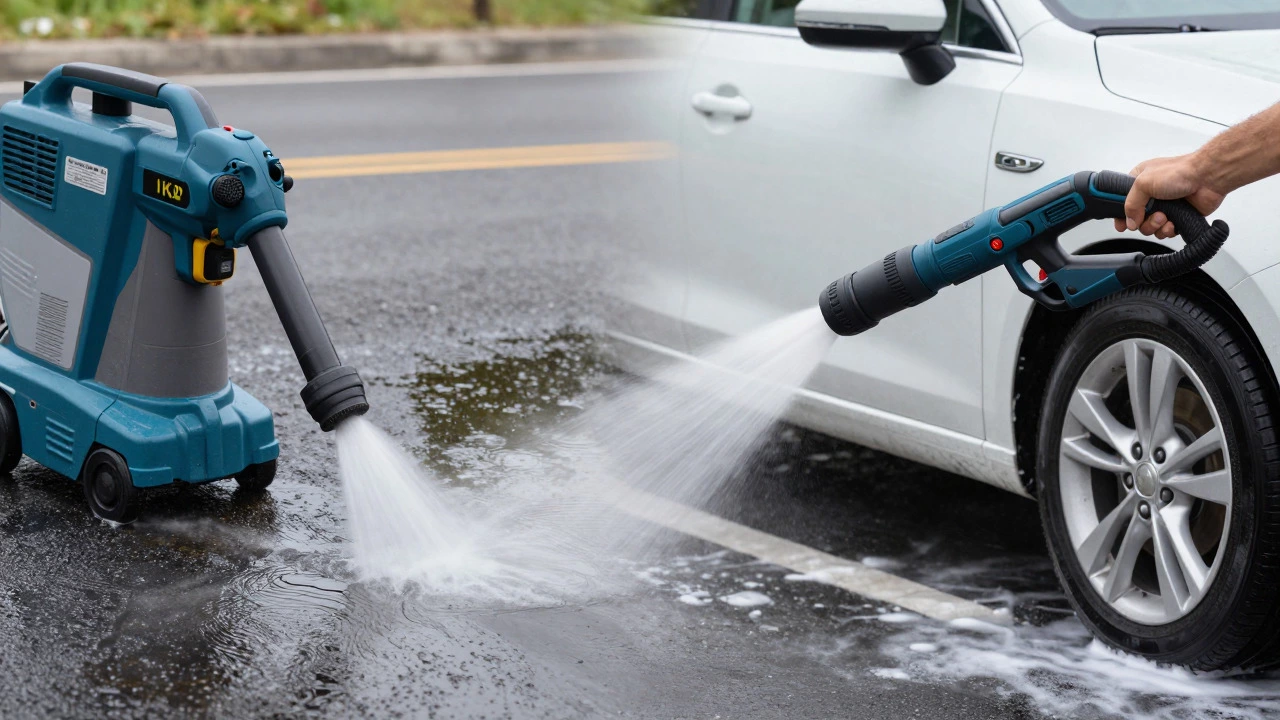
- Vehicles: High-end electric units or dedicated car wash systems. Low pressure (under 1,500 PSI) with a wide fan to prevent denting panels or peeling wax.
One common mistake amateurs make is thinking "more pressure is better." In reality, excessive pressure causes etching on concrete, which makes the surface rougher and dirtier over time. It also strips away protective sealants. Professionals know that the goal is to lift dirt, not blast the substrate away.
Maintenance and Longevity
A professional pressure washer is an investment, and like any heavy equipment, it needs care. Gas units require regular oil changes for the engine and lubrication for the pump. Electric units need less mechanical maintenance but still require descaling if you live in a hard water area like Bristol. Using unfiltered water can clog the tiny orifices in the nozzles and damage the pump seals within months.
Pros also drain their tanks before storing the unit for winter. Frozen water expands and can crack plastic housings and burst pump chambers. Keeping the machine covered and dry extends its lifespan significantly. A well-maintained commercial unit can last 5 to 10 years, whereas a neglected consumer model might fail after two seasons.
Frequently Asked Questions
Is a 3,000 PSI pressure washer good enough for professional work?
Yes, for most exterior cleaning tasks, 3,000 PSI is the sweet spot. It provides enough force to remove stubborn dirt from concrete and brick without causing significant damage. For very heavy industrial jobs, 4,000+ PSI is preferred, but 3,000 PSI covers 90% of residential and light commercial needs.
What is the difference between PSI and GPM?
PSI (Pounds per Square Inch) measures the force of the water, while GPM (Gallons per Minute) measures the volume of water flowing. Both matter. High PSI cleans small areas quickly, but high GPM rinses large areas faster. Professionals look for a balance, often prioritizing GPM for efficiency on big surfaces.
Can I use a professional pressure washer on my house siding?
Yes, but only if you adjust the settings. Use a wide fan nozzle (white or green) and keep the wand at least 10-15 feet away. Avoid direct high-pressure shots on vinyl siding, as it can bend the panels behind the seams. Start with the lowest effective pressure and increase only if necessary.
Do professionals use detergents with their pressure washers?
Almost always. Detergent helps break down organic growth like algae and moss, which water alone struggles to remove. Pros use soap injectors or foam cannons to apply chemical agents before rinsing. This reduces the required PSI and speeds up the cleaning process.
Which brand is best for professional pressure washing?
Top brands include Kärcher, Husqvarna, Nilfisk, and AR Blue Paint. Kärcher is widely regarded for its reliability and parts availability. Husqvarna is popular for its robust build quality. The "best" depends on your specific needs-Kärcher for versatility, Husqvarna for heavy-duty durability.