Pressure Washing Business Structure Advisor
Answer a few questions about your current or planned operation to get a tailored recommendation.
Sole Trader
Option A£100 - £300
Limited Company (Ltd)
Option B£800 - £1,500+
Why this recommendation?

Enter your details and click "Get Recommendation" to see which structure fits your business model best.
You’ve got the kit. You know how to strip years of grime off a driveway in an afternoon. But before you print those flyers or set up your Instagram page, there’s one decision that will shape your taxes, your liability, and your growth potential for years to come: what is the best business type for pressure washing?
It’s not just paperwork. Choosing between being a sole trader and forming a Limited Company changes how much you keep from every job, what happens if you accidentally blast a customer’s window pane, and whether banks will lend you money for that next trailer-mounted unit. In the UK, where the cleaning industry is booming but margins can be tight, getting this wrong costs real money.
The Quick Verdict
- Sole Trader: Best for beginners, low overheads, simple admin, and testing the market with minimal risk.
- Limited Company: Best for scaling, higher income (over £50k profit), seeking investment, or working with commercial clients who demand corporate structures.
- Hybrid Approach: Start as a sole trader, incorporate later when profits justify the accounting fees.
Understanding the Two Main Options
When you register with HMRC, you generally choose between two legal structures. There are others, like partnerships, but they’re rare in solo pressure washing operations unless you’re teaming up with another operator immediately.
Option 1: The Sole Trader
This is the default status for most people starting out. You are the business. There is no legal distinction between you and your trading entity. If you buy a hot water pressure washer on credit, you personally owe that money. If you slip and injure a client, you are personally liable.
Why do so many start here? Simplicity. You don’t need to file annual accounts with Companies House. You don’t need a separate business bank account (though it’s highly recommended). You just register for Self Assessment, track your income and expenses, and file one tax return a year. For a part-time operator doing weekend driveways, the administrative burden is near zero.
However, the downside is unlimited liability. Your personal assets-your house, your savings-are on the line if the business gets sued or goes into debt. In pressure washing, while rare, accidents happen. A high-pressure jet can shatter glass, damage render, or cause slips. Public liability insurance covers most incidents, but gaps exist.
Option 2: The Limited Company (Ltd)
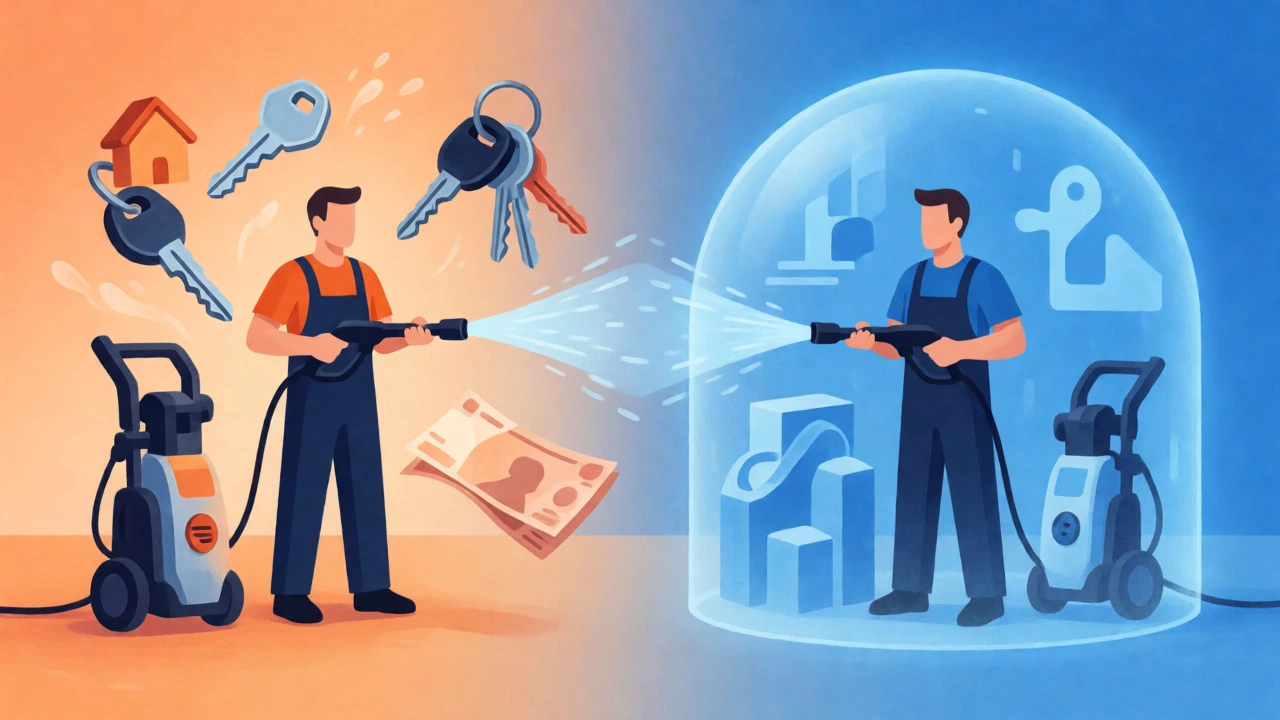
A Limited Company is a separate legal entity from you. It owns the equipment, signs the contracts, and incurs the debts. You are an employee and shareholder. This creates a "corporate veil" that protects your personal assets. If the company faces a lawsuit exceeding its insurance cover, only company assets are at risk, not your home.
Companies House requires you to file confirmation statements and annual accounts. You must appoint a director (you) and often a company secretary (can also be you). The complexity increases, and so does the cost. Accountancy fees for a Ltd company typically range from £800 to £1,500+ per year, compared to £100-£300 for a sole trader’s tax return.
| Feature | Sole Trader | Limited Company |
|---|---|---|
| Setup Cost | Free (HMRC registration) | £12-£100 (Companies House + Agent) |
| Admin Burden | Low (Self Assessment) | High (Annual Accounts, Confirmation Statement) |
| Liability | Unlimited (Personal assets at risk) | Limited (Company assets at risk) |
| Tax Efficiency | Income Tax + National Insurance | Corporation Tax + Dividends/Salary mix |
| Credibility | Good for residential | Better for commercial/B2B contracts |
Tax Implications: Where Does the Money Go?
This is where most operators get tripped up. The tax system changed significantly in recent years, especially regarding dividend taxation and the removal of certain allowances. Let’s look at the numbers for a typical scenario.
Imagine you make £40,000 profit after deducting fuel, chemicals, maintenance, and insurance.
As a Sole Trader: You pay Income Tax on the profit above your Personal Allowance (£12,570 as of 2024/25 rates, subject to change). You also pay Class 2 and Class 4 National Insurance Contributions (NICs). At £40k profit, your effective tax rate might hover around 20-25%. You take all the remaining cash directly into your pocket.
As a Limited Company: The company pays Corporation Tax on its profits (currently 19%-25% depending on profit bands). Then, you extract the remaining money via a combination of a small salary (to maximize pension credits and keep below NIC thresholds) and dividends. Dividend tax rates have risen, making the old trick of "low salary, high dividends" less potent than it was five years ago. However, for profits over £50,000, the Ltd structure often still offers better net retention because you control when you extract profits. You can leave money in the company to reinvest in new gear without triggering personal tax events.
If you’re making under £30,000 profit, the accounting fees of a Ltd company likely eat up any tax savings. You’d be paying more in admin costs than you save in tax. Above £50,000, the scales tip toward incorporation.
Insurance and Liability Risks
Pressure washing isn’t just about dirt; it’s about force. Water hitting concrete at 3,000 PSI can erode mortar, crack tiles, or send debris flying into parked cars. Public Liability Insurance is non-negotiable.
Insurers view Limited Companies slightly differently than sole traders. Some insurers offer lower premiums for Ltd companies because the separation of assets suggests a more formalized risk management approach. However, the primary factor is your claims history and the specific services offered. Do you work at height? Do you use hot water? These increase premiums regardless of structure.
Crucially, if you hire employees, you need Employers’ Liability Insurance. This is mandatory by law in the UK once you have staff. Sole traders hiring their first helper must secure this immediately. Fines for missing coverage can reach £2,500 per day. Many sole traders avoid hiring to dodge this cost, limiting their ability to scale. A Ltd company handles payroll and PAYE more naturally, making hiring less administratively painful.
Perception and Commercial Contracts
Who is your ideal client? If you’re targeting homeowners for driveway cleanups, being a sole trader is fine. Neighbors trust neighbors. They want a reliable local guy, not a faceless corporation.
But if you want to bid for council contracts, manage estates for housing associations, or service large retail parks, things change. Procurement departments often prefer dealing with Limited Companies. Why? Because Ltd companies provide clearer audit trails, VAT registration options, and perceived stability. A sole trader going bankrupt can disrupt a contract mid-term; a Ltd company can theoretically survive a director’s departure.
VAT registration is another factor. Once your taxable turnover exceeds £90,000 (the threshold may adjust, check current HMRC rules), you must register for VAT. As a sole trader, you charge VAT on top of your prices, which can deter price-sensitive residential customers. As a Ltd company, you can reclaim VAT on your expensive equipment purchases (like a £5,000 hot water unit), offsetting the cost of charging VAT to clients. This makes the Ltd structure financially advantageous for B2B work where clients can reclaim VAT themselves.
Financing and Growth Potential
Want to expand? Maybe you want to buy a second van, a trailer, or a larger stationary unit. Banks are cautious with sole traders. They see you as the business-if you get sick, revenue stops. Loans for sole traders often require personal guarantees and stricter credit checks.
Limited Companies can raise capital more easily. You can issue shares to bring in a silent partner. You can access asset finance deals specifically structured for corporate entities. If you plan to build a brand-perhaps franchising your model or hiring a crew of five-the Ltd structure provides the framework needed for complex ownership and exit strategies.
When Should You Switch?
You don’t have to decide forever today. Many successful operators start as sole traders, test their pricing, build a client base, and then incorporate once they hit a tipping point.
Consider switching to a Limited Company if:
- Your annual profit consistently exceeds £40,000-£50,000.
- You are winning contracts with commercial clients requiring Ltd status.
- You plan to hire multiple employees and need streamlined payroll.
- You want to retain earnings in the business for equipment upgrades rather than taking them all as personal income.
- You are concerned about personal asset protection due to high-risk jobs (e.g., industrial sites).
Conversely, stay a sole trader if:
- You are working part-time or testing the waters.
- You want to minimize bookkeeping headaches.
- Your profits are modest (<£30k).
- You operate locally with low liability risks.
Practical Steps to Get Started
Regardless of your choice, here’s the immediate checklist for launching your pressure washing venture in the UK:
- Register with HMRC: Do this within three months of starting trading. Late registration attracts fines.
- Open a Business Bank Account: Even as a sole trader, keep finances separate. It saves hours during tax season.
- Get Insurance: Secure Public Liability (minimum £2m cover is standard) and Equipment Insurance. If hiring, add Employers’ Liability.
- Understand IR35: If you contract through agencies, understand if you fall inside or outside IR35 rules, though this affects Ltd contractors more than direct-to-client cleaners.
- Set Up Accounting Software: Use tools like Xero, QuickBooks, or FreeAgent. They integrate with bank feeds and simplify VAT returns.
Final Thoughts on Your Choice
There is no single "best" business type for everyone. It depends on your ambition, your risk tolerance, and your financial goals. For the majority of individuals starting a pressure washing side hustle or small operation, the Sole Trader route is the logical first step. It keeps costs low and flexibility high. You can always incorporate later. Don’t let the fear of paperwork stop you from picking up the lance.
Do I need to register for VAT immediately when starting a pressure washing business?
No. You only need to register for VAT if your taxable turnover exceeds the current threshold (typically £90,000 over a rolling 12-month period). You can voluntarily register earlier if you want to reclaim VAT on equipment, but this obligates you to charge VAT on your services, which may reduce competitiveness in the residential market.
Can I switch from sole trader to limited company later?
Yes, absolutely. This process is known as "incorporating." You form a new Limited Company and transfer the assets of the sole trader business to it. There may be tax implications regarding the transfer of assets (known as Incorporation Relief), so consulting an accountant during the switch is advisable.
What is the main disadvantage of being a sole trader?
The primary disadvantage is unlimited liability. If your business incurs debts or faces a lawsuit exceeding your insurance coverage, your personal assets (home, car, savings) are at risk. Additionally, you cannot issue shares to raise capital, limiting external investment options.
Is it cheaper to be a sole trader or a limited company?
For low profits (under £30,000), being a sole trader is generally cheaper due to lower accounting and compliance costs. For higher profits, a Limited Company can be more tax-efficient despite higher admin fees, allowing you to retain more net income through salary and dividend optimization.
Do commercial clients prefer limited companies?
Many commercial clients, such as councils, property management firms, and large retailers, prefer or require suppliers to be Limited Companies. This is due to procurement policies, perceived stability, and easier processing of invoices and VAT reclaims.