
Streak-Free Window Cleaning Duration Calculator
See how long your window stays clean based on the water type used. Professional window cleaners use distilled water to avoid streaks and residue.
Results will appear here...
Professional window cleaners avoid soap to prevent residue. Use distilled water only for streak-free results that last 4-6 weeks.
Ever watched a window cleaner climb a ladder with nothing but a bucket of water and a squeegee? No sponge. No detergent. No bubbles. It looks odd-until you see the result: streak-free, crystal-clear glass that lasts for weeks. So why don’t they use soap? It’s not because they’re lazy or cheap. It’s because soap is the enemy of perfect windows.
Soap Leaves Behind Residue
Most household cleaners, even the ones labeled ‘for glass,’ contain surfactants, fragrances, and oils. These ingredients help lift dirt and grease, but they don’t fully rinse away. What’s left behind? A thin, invisible film. On a sunny day, that film catches the light and turns into streaks, smears, and haze. You wipe it once, it looks better. Wipe it again, and the streaks just move around. After a few days, the glass looks worse than before you cleaned it.Professional window cleaners don’t want to clean windows-they want to make them disappear. That means zero residue. Soap, no matter how mild, fights that goal. Even ‘eco-friendly’ soaps leave something behind. And on large commercial buildings with hundreds of windows, that residue adds up fast. One smudged pane out of fifty is a complaint. One smudged pane out of five hundred? That’s a lost client.
Distilled Water Is the Secret Weapon
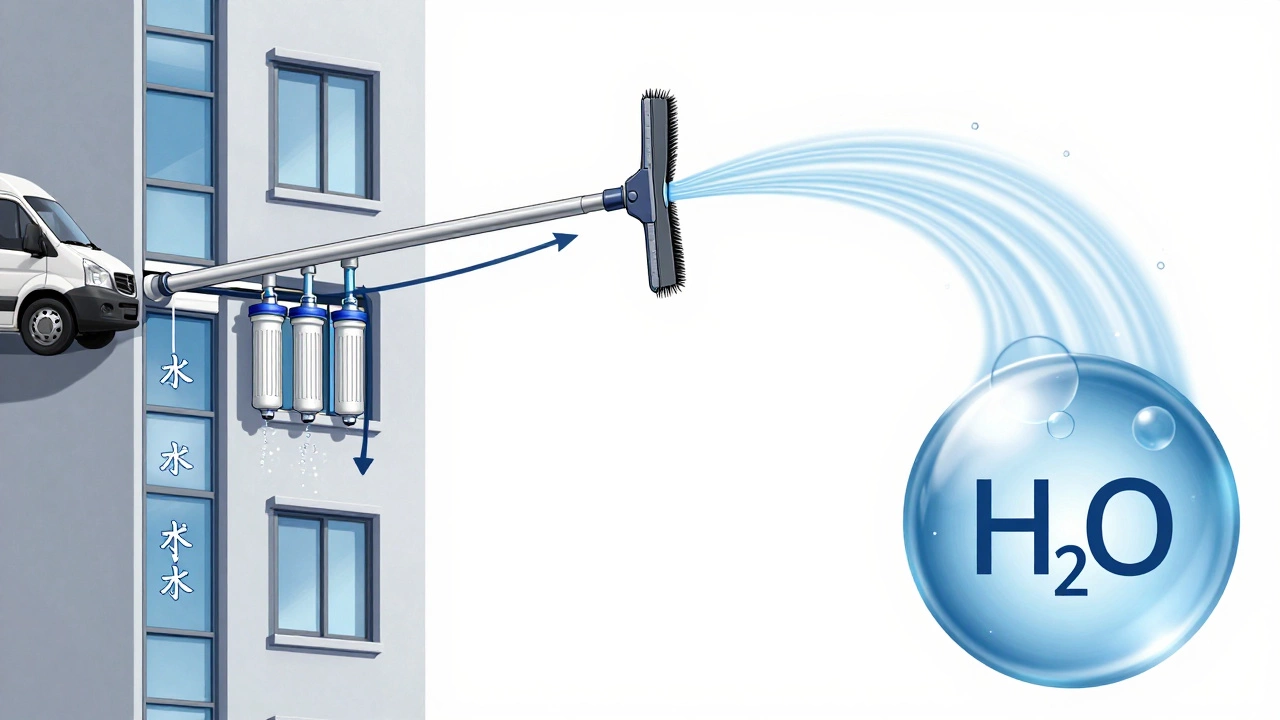
Instead of soap, most pros use purified water-specifically, distilled or deionized water. This isn’t tap water. Tap water has minerals: calcium, magnesium, iron, chlorine. When it dries, those minerals stick to the glass like tiny crystals. That’s why your bathroom mirror gets cloudy after you shower. Distilled water removes all those minerals. No solids. No deposits. Just H₂O.Here’s how it works: the cleaner dips a brush into the water, scrubs the glass gently, then uses a squeegee to pull the water off in one smooth motion. The water evaporates completely-leaving nothing behind. No streaks. No spots. No film. It’s science, not magic. In fact, many companies now use water-fed poles with built-in filtration systems. They fill a tank with purified water, send it up a long pole to a brush on the end, and clean windows from the ground. No ladders. No soap. Just water.
Why Tap Water Doesn’t Work
You might think, “I use tap water and vinegar at home-it works fine.” But vinegar is acidic, and it breaks down mineral buildup. It doesn’t prevent it. And if your tap water is hard (common in Bristol and much of the UK), you’re adding more minerals to the glass than you’re removing. Vinegar helps, but it’s not a long-term fix. The streaks come back faster than you think.Try this: wash a window with tap water, let it dry in sunlight, then wipe it with a dry microfiber cloth. See those white marks? That’s mineral residue. Now do the same with distilled water. No marks. No haze. Just clarity. That’s why professionals carry water purification units in their vans. They’re not being fancy-they’re being precise.
The Squeegee Isn’t Just a Tool-It’s the Technique
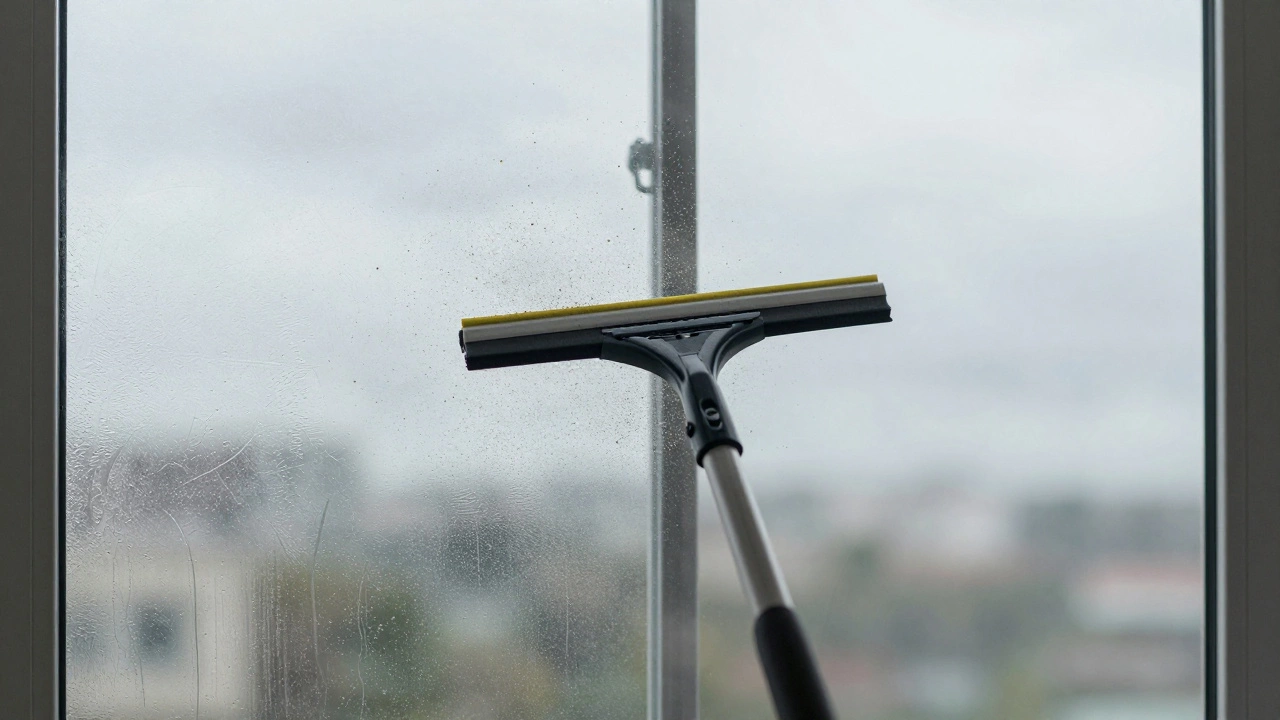
Using water alone only works if you remove it properly. That’s where the squeegee comes in. A good squeegee has a flexible rubber blade that hugs the glass tightly. The trick isn’t just pulling it down-it’s pulling it in one continuous motion, overlapping each stroke slightly, and wiping the blade clean after every pass.Most amateurs use a cloth or paper towel. That’s fine for small mirrors or car windows. But for full-size windows, cloth fibers leave lint. Paper towels leave tiny bits. Even lint-free cloths can trap dust and create micro-scratches over time. A squeegee doesn’t touch the glass with anything but water. It’s the cleanest, most efficient way to remove liquid without introducing new contaminants.
What About Tough Stains?
You might be thinking: “What if there’s bird droppings, paint splatter, or old adhesive? Can’t soap help there?”Yes-but not on the glass itself. Professionals use a separate tool for stubborn spots: a plastic scraper for dried glue or paint, or a mild alkaline cleaner applied only to the spot, then rinsed off immediately with purified water. They never soak the whole window in cleaner. They treat the stain like a wound-local, quick, and precise. Then they go back with pure water and the squeegee to restore the glass to its original state.
Using soap on the entire pane is like using a hammer to fix a loose screw. It might seem to work, but it’s the wrong tool for the job.
Why This Method Lasts Longer
A window cleaned with soap might look good right after, but it attracts dust faster. Why? Because the residue left behind is slightly sticky. Dust, pollen, and airborne particles cling to it. Within a week, the glass looks dirty again.Windows cleaned with purified water and a squeegee stay clean for 4-6 weeks, sometimes longer. No sticky film. No attractants. Just smooth, neutral glass. In commercial settings-like office towers or retail stores-that means fewer cleanings per year. Less labor. Less cost. Better appearance.
It’s Not Just About Cleanliness-It’s About Consistency
Imagine cleaning 50 windows in a building. Some get soap. Some get water. Some get a cloth. The results? Uneven. One window sparkles. Another has a faint haze. Another has lint trails. Clients notice. Inspectors notice. You lose trust.Professional window cleaning is a system. It’s not about being clever. It’s about being repeatable. Purified water + squeegee = consistent results, every time. That’s why the method hasn’t changed in 50 years. It’s not outdated. It’s perfected.
Can You Do This at Home?
Yes-but you need the right tools. You don’t need to buy a $2,000 water-fed pole. But you do need distilled water and a good squeegee. You can buy distilled water at any grocery store-look for it near the bottled water or in the automotive section. A 5-liter jug costs less than £3.Here’s your simple home setup:
- Fill a spray bottle with distilled water.
- Wipe the window with a soft brush or sponge (a clean dishcloth works in a pinch).
- Use a rubber-bladed squeegee to remove the water in vertical strokes.
- Wipe the blade with a lint-free cloth after each pass.
Don’t use paper towels. Don’t use vinegar unless you’re removing hard water stains. And never, ever use dish soap. Even a drop will leave a film.
Try it on one window. Wait a day. Look at it in the morning light. Then look at your other windows. The difference isn’t subtle. It’s obvious.
Why the Myth Persists
People still think soap makes things cleaner because that’s what we’ve been taught. Soap cleans dishes. Soap cleans floors. Soap cleans clothes. So why not windows?Because windows aren’t dishes. They’re mirrors. They’re portals. They’re meant to reflect the world without distortion. Soap distorts. Water doesn’t.
The window cleaner standing on the ladder with a bucket of plain water? They’re not being strange. They’re being expert.